Industry
Treatments, Synthetics & Imitations
HPHT, irradiation, laser drilling and the rest — how diamonds are enhanced or imitated, and how the lab tells.
Modern technology has advanced both diamond treatments and synthetic diamonds enormously, and their lower prices have drawn real interest. The difficulty is that they can be hard to detect, which opens the door to misrepresentation and non-disclosure. One principle settles all of it.
A note on value before the methods. Treated diamonds are heavily discounted: the stones chosen for treatment are often poor to begin with — low colour, low clarity, sometimes both — so their price is not set by what they have become. Synthetic diamonds are expensive to grow at size, which is why few exceed 0.40 ct; both treated and synthetic stones tend to sell at roughly $100 to $500 per carat. HPHT and laser-treated diamonds are the exceptions, since they often pass 0.70 ct and look more natural — these are priced off the Rapaport figure for natural, untreated stones, at a discount of -50% to -70%.
HPHT
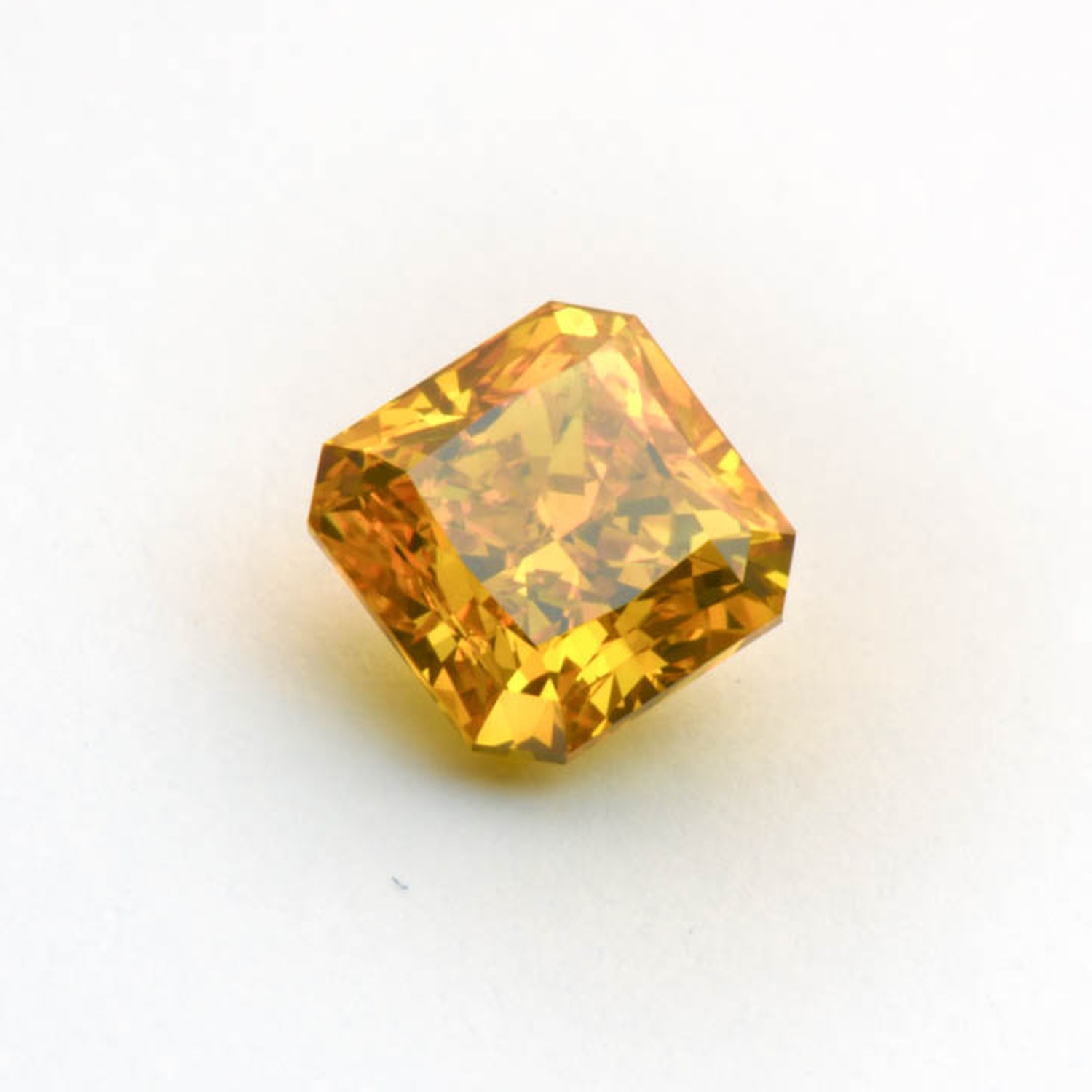
HPHT diamonds are natural diamonds whose colour has been enhanced through High Pressure High Temperature treatment. The method, developed by General Electric and Lazare Kaplan, Inc., was introduced in 1999 and trademarked “Bellataire” (formerly “Pegasus”). It is performed mostly on brown type IIa diamonds that fluoresce green under UV — a rare type, only about 1.8% of all diamonds, and rarer still in that colour. Such stones are inexpensive precisely because their brown is the mark of an irregular crystal lattice, a so-called plastic deformation.
The treatment recreates the conditions in which diamonds form: temperatures of roughly 1,900°C to 2,100°C and pressures around 6 gigapascals. The lattice is, in effect, repaired, usually enhancing colour — though not always predictably. Some stones turn colourless; others go greenish-yellow, yellowish-green, yellow, even blue or pink. High-clarity rough is preferred, since inclusions may darken or fracture under treatment. In the lab, HPHT stones are detectable by low-temperature visible and photoluminescence spectroscopy, and tend to show banded internal graining, graphitised “feathers” and altered inclusions ringed by radial fractures. Most treaters laser-inscribe the girdle to aid identification — though labs have reported uninscribed stones, the girdle either re-polished or never marked, a reminder that vigilance is always required. Colourless HPHT diamonds sell 50% to 70% under Rapaport, according to how well the treatment took.
Irradiation
Sir William Crookes was the first to test radiation on diamond, in 1904. Experimenting with radium salts, he found that alpha particles turned diamonds a dark green, blotched across the surface — but the stones were highly radioactive, and unwearable. Today’s methods are safe and produce wearable colour by four routes: proton and deuteron bombardment by cyclotron; gamma rays from cobalt-60; neutron bombardment in nuclear reactors; and electron bombardment by Van de Graaff generator. Radioactivity fades within hours. Neutron bombardment gives green-to-black stones with full colour penetration; electron bombardment gives blue, blue-green or green, penetrating only about a millimetre.
Like HPHT, irradiation alters the lattice — and so the absorption spectrum. Almost every irradiated diamond is recognisable by the GR1 line, a fine line in the far red at 741 nm. Natural blue diamonds, by contrast, give themselves away through their semi-conductivity — a property of the boron in their structure that irradiation cannot mimic. Heat treatment afterward, known as annealing, yields orange, yellow, brown and pink, the final colour depending on composition and on temperature and time: electron-irradiated stones need 500°C to 1,200°C, neutron-irradiated stones 500°C to 900°C. Annealing usually destroys the GR1 line but creates new ones, the strongest at 595 nm. Because irradiation and heat also occur naturally in the earth, telling a natural fancy colour from an artificial one can be genuinely difficult — another reason to insist on a laboratory certificate.
Laser Drilling
When a diamond is heavily included, its appearance can be improved by laser — a commercial practice since the 1970s for stones whose inclusions are visible to the naked eye. An infrared laser (around 1,060 nm) drills microscopic channels to the dark inclusions, typically pyrite or magnetite, through which acid is then introduced to burn out, bleach or dissolve them. The drilling reaches a depth of about 1.6 mm and a diameter of 20 to 60 microns at a time, and takes some 30 to 45 minutes.
The improvement is real — the inclusions vanish from naked-eye view — but the clarity grade does not change. The inclusions, however faint, remain, and the drill holes themselves count as additional artificial inclusions. More recently, drill holes have been filled with a highly refractive wax or synthetic resin and sealed at the surface, which makes them less obvious and keeps out dust, though they can still be discerned in reflective light. A laser-treated diamond is worth roughly 5% to 20% less than an untreated stone of the same grades.
Fracture Filling (Yehuda)
Where laser drilling clears an inclusion, fracture filling hides one. Surface-reaching fractures and feathers are filled with a glass-like substance whose refractive index is close to the diamond’s, so the break all but disappears and the stone reads cleaner than it is. The grade, again, is not improved — and the fill is not permanent: heat from a jeweller’s torch or even ultrasonic cleaning can damage it. The tell is a flash effect along the filled fracture, a flicker of colour — orange or pink against the diamond, blue or violet with it — as the stone is rocked under the loupe. Disclosure is essential, and any competent laboratory will identify the treatment.
Synthetics
A synthetic diamond is a true diamond — the same carbon, the same lattice, the same hardness — grown in a laboratory rather than the earth. Two methods dominate: HPHT growth, which crystallises carbon under the same heat and pressure that formed natural stones, and CVD (chemical vapour deposition), which builds the crystal layer by layer from a carbon-rich gas. They are not imitations; they are diamonds, and must simply be disclosed as laboratory-grown. Growing them at size remains costly, which is why large synthetics are uncommon. Gemological laboratories distinguish them from natural stones by their growth structure, distinctive fluorescence patterns and characteristic trace features — routine work for a properly equipped lab, and the reason certification matters.
Imitations
An imitation is not a diamond at all — only something that resembles one. Cubic zirconia and moissanite are the common modern stand-ins; older or rarer ones include white sapphire, white topaz, YAG and GGG, and plain glass (“paste”). Each parts from diamond in ways a gemologist can read: weight and density, hardness, thermal and electrical conductivity, and optical behaviour. Moissanite, notably, can fool a basic thermal tester and needs a dedicated instrument to expose. None of them withstands proper testing — which, once more, is why the laboratory certificate is the only assurance worth relying on.
Related reading