The Grader
Colour
Why the rarest white diamonds are the most colourless of all — and how the D-to-Z scale reads the faint warmth most stones carry.
Typically diamonds are transparent with barely perceptible hints of colour. With the exception of fancy-coloured diamonds — where colour is the prize — the rarest diamonds are the most colourless. Grades run from D to Z, D being the rarest of all.
In its purest state a diamond is carbon and nothing else. Such purity is rare: as the crystal grows, stray atoms of other elements become caught among the carbon, and it is their presence that gives a stone its tint. Nitrogen is the usual culprit, lending the faint yellow warmth the scale measures. The less of it a diamond carries, the more colourless — and the more prized — the stone.
Reading the scale
| Grade | GIA category | Old-world name |
|---|---|---|
| D – F | Colourless | Exceptional white · Rare white |
| G – J | Near colourless | Fine white · Top crystal |
| K – M | Faint | Top cape · Crystal |
| N – R | Very light | Very light yellow |
| S – Z | Light | Light yellow |
Colourless (D–F). The top of the scale. D–F stones show virtually no colour and are valued accordingly; the difference between them is visible only to a trained grader against a comparison set.
Near colourless (G–J). Excellent value. Faint warmth exists but is hard to detect once the stone is set, especially in white-gold or platinum mounts.
Faint to light (K–Z). A warmth becomes perceptible, most often from nitrogen scattered through the lattice. Many buyers find a warm K beautiful in yellow gold, where the metal flatters the tint.
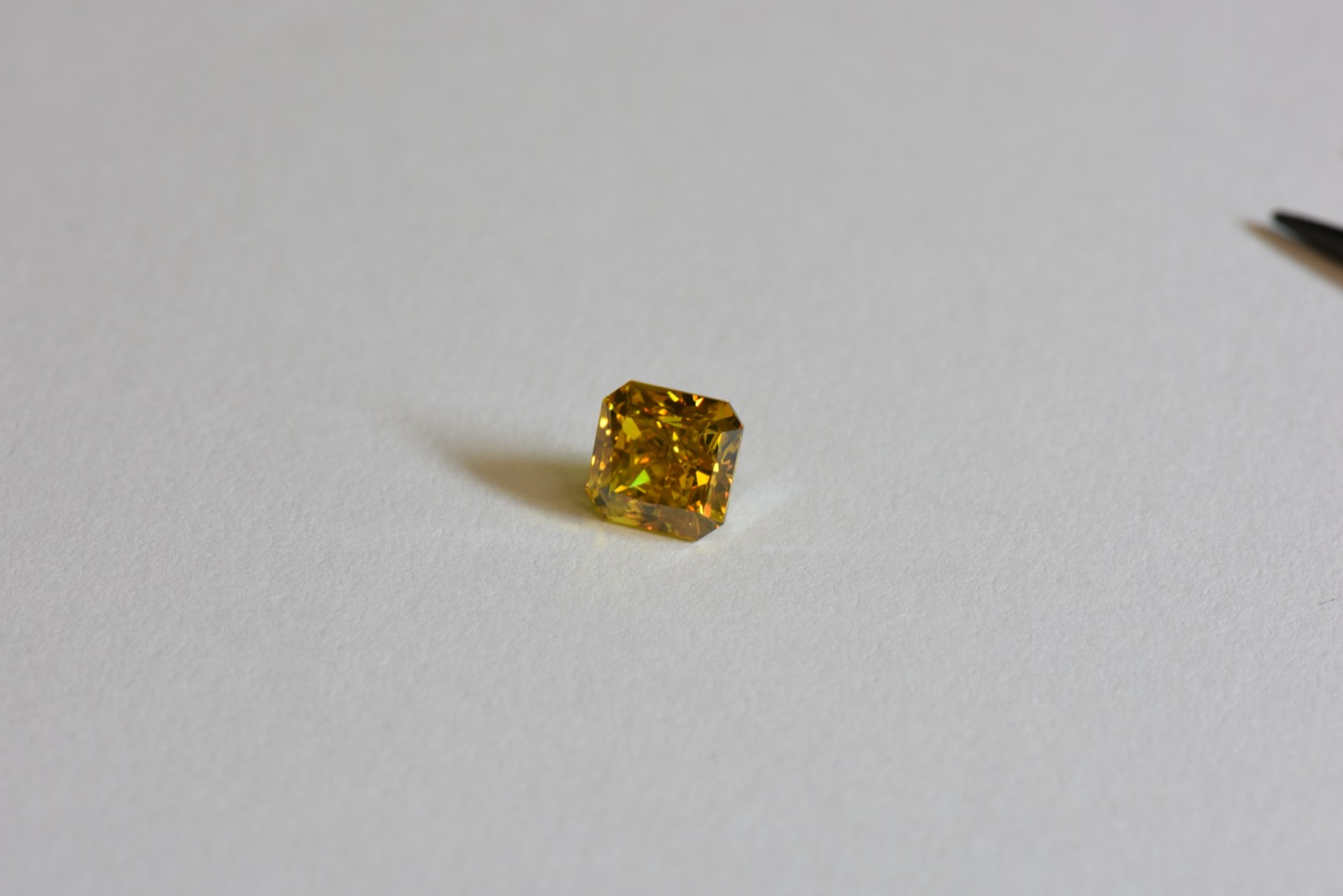
Beyond the bottom of the scale, the rules invert: when colour deepens past Z into a true, saturated hue, a diamond is no longer “tinted” but fancy-coloured — and among the rarest, most valuable stones on earth.
Related reading